
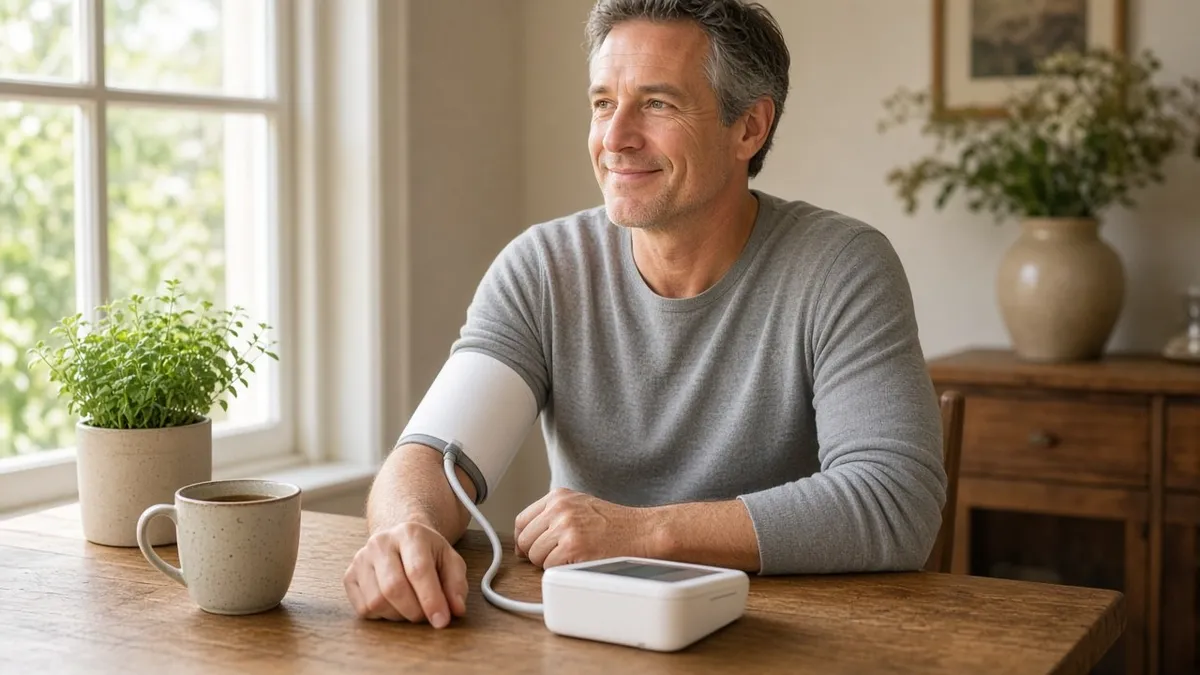
Many people expect high blood pressure to cause a headache or another warning sign. But according to the American Heart Association (AHA), high blood pressure usually has no warning signs or symptoms, which is why it's often called a "silent killer." Measuring your blood pressure is the only way to know whether it's high [S1].
So don't use a headache, or the lack of one, to judge your blood pressure. Get it measured.
Why it matters
High blood pressure raises the risk of heart attack, stroke, heart failure, kidney disease and dementia [S4].
What the numbers mean
The 2025 AHA/ACC high blood pressure guideline uses these categories for adults [S3]:
| Category | Top number (systolic) | Bottom number (diastolic) | |
|---|---|---|---|
| Normal | less than 120 | and | less than 80 |
| Elevated | 120–129 | and | less than 80 |
| Stage 1 high blood pressure | 130–139 | or | 80–89 |
| Stage 2 high blood pressure | 140 or higher | or | 90 or higher |
The category is based on the average of two or more readings taken on two or more occasions. If your top and bottom numbers fall in different categories, the higher category applies [S3]. A diagnosis is made by a health care professional [S1].
One high reading at home
According to the AHA, a single high reading at home is not an immediate cause for alarm. Wait a little, take it again, write down both readings and check with your health care professional [S1].
When to call 911
If your blood pressure is higher than 180/120, wait one minute and take it again [S2].
- If it's still that high and you have chest pain, shortness of breath, back pain, numbness, weakness, a change in vision or difficulty speaking, call 911 [S2].
- If it's still that high and you have none of those symptoms, contact your health care professional right away [S2].
How often to check
The AHA advises adults 20 and older whose blood pressure is normal to have it checked at least once a year [S1]. The 2025 guideline also recommends measuring blood pressure at home [S4]. Ask your health care professional how often you should check.
Lifestyle habits that help
The AHA's summary of the 2025 guideline lists these habits for preventing and managing high blood pressure [S4]:
- Keep sodium under 2,300 mg a day, ideally moving toward 1,500 mg.
- Follow a heart-healthy eating pattern such as DASH.
- If you're overweight, lose at least 5% of your body weight.
- Be physically active (the AHA cites at least 75 to 150 minutes a week).
- Ideally, don't drink alcohol. If you do, limit it to no more than 2 drinks a day for men and 1 for women.
- Manage stress with exercise, meditation, breathing exercises or yoga.
Your health care professional will tell you which steps fit your situation.
Questions in Miami?
FE Medical Center offers primary care visits. For the emergency symptoms listed above, call 911; do not call or come to the clinic. FE Medical Center, 7800 Coral Way, Miami, FL 33155, (305) 703-3710 · Book an appointment: https://www.femedicalcenter.com/contact
Individual results vary. This article is general health information. It does not replace an evaluation by a licensed health care professional and is not a diagnosis or a treatment plan. If you think you have a medical emergency, call 911.
FAQ
Does high blood pressure cause headaches?
You can't count on it. The AHA says high blood pressure usually has no symptoms, and measuring is the only way to know if it's high [S1].
What blood pressure is an emergency?
Above 180/120. Retake it after one minute; if it's still that high and you have symptoms such as chest pain, shortness of breath, numbness, weakness, vision change or difficulty speaking, call 911 [S2].
What is a normal blood pressure?
Less than 120 over less than 80 [S3].
Sources
[S1] American Heart Association. What are the Signs and Symptoms of High Blood Pressure? Last reviewed Aug 14, 2025. https://www.heart.org/en/health-topics/high-blood-pressure/know-your-risk-factors-for-high-blood-pressure/what-are-the-symptoms-of-high-blood-pressure · accessed Oct 22, 2026.
[S2] American Heart Association. When To Call 911 About High Blood Pressure. Last reviewed Aug 14, 2025. https://www.heart.org/en/health-topics/high-blood-pressure/understanding-blood-pressure-readings/when-to-call-911-for-high-blood-pressure · accessed Oct 22, 2026.
[S3] Jones DW, Ferdinand KC, Taler SJ, et al. 2025 AHA/ACC/AANP/AAPA/ABC/ACCP/ACPM/AGS/AMA/ASPC/NMA/PCNA/SGIM Guideline for the Prevention, Detection, Evaluation, and Management of High Blood Pressure in Adults. Circulation. Published Aug 14, 2025. doi:10.1161/CIR.0000000000001356 (also J Am Coll Cardiol, doi:10.1016/j.jacc.2025.05.007) · accessed Oct 22, 2026.
[S4] American Heart Association News. New high blood pressure guideline emphasizes prevention, early treatment to reduce CVD risk. Aug 14, 2025. https://newsroom.heart.org/news/new-high-blood-pressure-guideline-emphasizes-prevention-early-treatment-to-reduce-cvd-risk · accessed Oct 22, 2026.